
IR vs SR vs EC Pellets: Key Differences Explained

IR vs SR vs EC Pellets: Key Differences Explained
The release of an active pharmaceutical ingredient (API) in pharmaceutical formulation and drug delivery can have a significant impact on the treatment. Some patients may need the drug to act quickly; others may require long-term drug protection or maintain a specific level of drug. Still others need to maintain protection of the API against a rough gastric environment. These needs can be met through special pellet technologies such as IR vs SR vs EC Pellets.
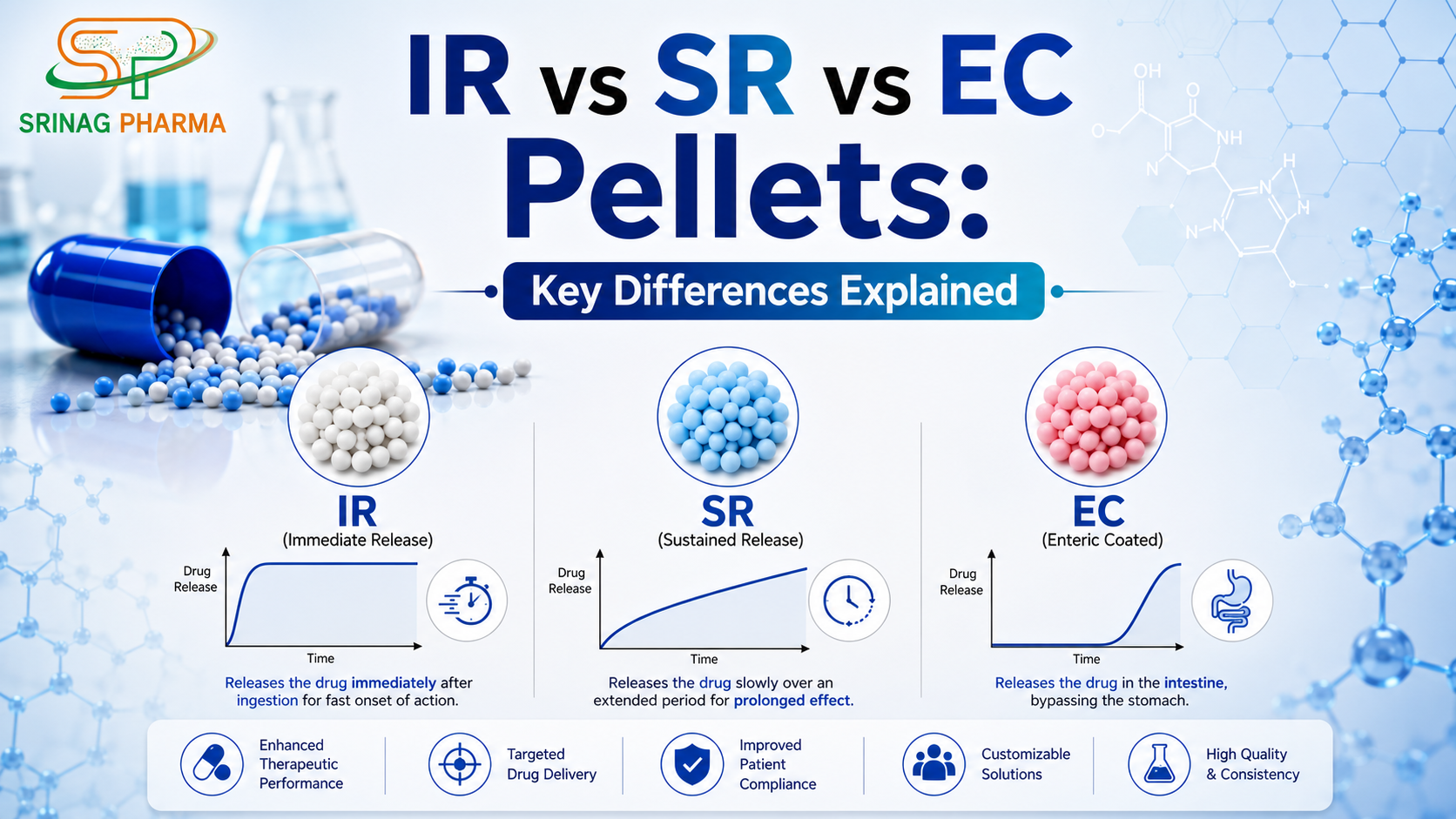
In today's pharmaceutical production, Immediate Release (IR), Sustained Release (SR), and Enteric Coated (EC) pellets are frequently utilized. While all three kinds of pellets exist to release APIs, they vary in release mechanism, coating technologies, therapeutic intents, and applications. The differences among IR, SR, and EC Pellets can be summarized as follows.
What Are IR, SR, and EC Pellets?
Let's give a brief on what each of IR, SR & EC Pellets is expected to do:
Immediate Release (IR) Pellets
The Immediate Release pellets are designed to release the active pharmaceutical ingredient (API) immediately after administration. They are generally made to dissolve or disintegrate rapidly in the gastrointestinal fluids upon administration.
IR pellets are appropriate for drugs that should act quickly. They can be the content in a capsule or be combined with other oral drugs to produce different dosage forms, depending on the form of the drug.
Sustained Release (SR) Pellets
As the name suggests, the Sustained Release pellets are designed to release the active ingredient (API) over a period of time. The release of the drug is controlled by the different polymer coatings, which provide the specific controlled release.
This may reduce the number of doses needed and assist with patient compliance and convenience.
Enteric Coated (EC) Pellets
The Coat pellets help to protect the API from the gastric acid environment or to prevent the release of the drug until it has reached the intestine.
The enteric coating is stable to the acid pH found within the gastric environment, but breaks down or becomes permeable at an increased pH of the intestinal environment, enabling the release of the API.
IR vs SR vs EC Pellets: Key Differences
The main distinction between these types of pellet systems is how and where the drug is released.
| Feature | IR Pellets | SR Pellets | EC Pellets |
|---|---|---|---|
| Release profile | Rapid | Controlled over an extended period | Delayed until intestinal conditions |
| Primary purpose | Fast therapeutic action | Prolonged drug delivery | Gastric protection or intestinal targeting |
| Coating requirement | Minimal or functional coating | Release-controlling polymer coating | pH-dependent enteric coating |
| Typical release location | Stomach and intestine | Gastrointestinal tract over time | Mainly intestine |
| Main benefit | Rapid API availability | Reduced dosing frequency | Protection from gastric acid |
| Common application | Fast-acting oral medicines | Long-duration therapies | Acid-sensitive or gastric-irritant APIs |
The selection of one system over the other is determined by the physicochemical properties of the API, therapeutic, patient population, and the targeted release profile.
Benefits of Immediate Release Pellets
IR pellets are commonly employed in case rapid release of API is desirable.
Some key benefits include:
- Faster drug release
- Quick onset of therapeutic action
- Flexible dosage formulation
- Uniform API distribution
- Can be used for medicines that need to be absorbed quickly
- Compatibility with capsule-based formulations
The manufacturing process can also deliver more uniform drug distribution than some conventional dosage forms.
Benefits of Sustained Release Pellets
Also interesting for APIs that lend themselves to controlled drug release are SR pellets.
Their advantages include:
- Prolonged drug release
- Reduced dosing frequency
- More consistent drug concentrations
- Improved patient convenience
Prolonged controlled drug delivery
Many Sustained Release Pellets are made using certain other polymers which control drug diffusion or dissolution.
Benefits of Enteric Coated Pellets
EC pellets are useful when the drug should be protected from gastric pH or if the API requires delivery to the intestine.
Key benefits include:
- Protection against stomach acid
- Protection of acid-sensitive APIs
- Decreased gastric irritation for specific medications
- Targeted intestinal drug release
- Improved formulation stability
The enteric coating pellets are designed by using polymers that are pH sensitive. These take varying responses to different regions of the gastrointestinal tract.
How Do Pellet Coatings Control Drug Release?
Coating Technology ensures the defining characteristic and makes the important one among the comparison for the 'IR vs SR vs EC Pellets'.
In SR formulations, polymer coatings act as a membrane of controlled release. This membrane permits the GI fluid flux into the pellet and the API flux outside.
The pH-sensitive coating for EC formulations is used to avoid drug release in the stomach and to release after reaching a proper intestinal environment.
The final release profiles can be affected by the coating thickness, makeup, and uniformity. Proper coating methods and quality control are required to obtain reliable results.
Factors to Consider When Choosing Pellet Technology
When choosing between IR, SR, and EC formulations, pharmaceutical manufacturers should evaluate:
API Properties
The optimal release system is determined by solubility, stability, permeability, and sensitive API.
Therapeutic Objective
If a quick response is needed, and for long term drug delivery, SR Pellets may be better, and EC Pellets are preferred in case of protection of the stomach or release in the intestines.
Patient Requirements
Dose frequency and length of treatment may be important considerations when selecting a pellet technology.
Manufacturing Considerations
Evaluation of coating materials, equipment, process control, as well as regulatory requirements should be performed during formulation development.
Why Choose a Reliable Pellet Manufacturer?
The manufacturing expertise is crucial for quality pharmaceutical pellets. A good Pharmaceutical Pellet Manufacturer should demonstrate suitable process capabilities, quality control measures, and the relevant technical expertise to produce batch-to-batch consistent release profiles.
Important considerations include:
- Advanced pelletization technology
- Controlled coating processes
- Strong quality management systems
- Analytical testing capabilities
- Regulatory compliance
- Batch-to-batch consistency
- Customized formulation support
Partnering with an established manufacturer can help drug companies to ensure consistent performance and a high quality standard.
Conclusion
An overview of IR vs SR vs EC Pellets is very important in the formation of optimal strategies for oral drug delivery systems. IR pellets are a system for immediate or instant release. SR pellets are for sustained release, offering control over the delivery rate. EC pellets (enteric-coated) systems protect against stomach acids or deliver drugs in the intestine.
The ideal pellet technology will vary based on the API, the therapeutic application, the required release profile, and the patient's needs. Working closely with a specialized Pharmaceutical Pellet Manufacturer, a developer of a new drug can choose a suitable formulation platform and produce an effective, high-quality dosage form.
Frequently Asked Questions
-
1.What is the difference between IR, SR, and EC pellets?
IR pellets are developed to disperse the API rapidly. The SR pellets are developed with properties to disperse the API over a long period of time. The EC pellets are developed with pH-sensitive coating to release the API once they reach the intestine.
-
2.Which is better: IR, SR, or EC pellets?
Nothing is inherently better—the correct pellet system varies based on API, therapeutic goal, release characteristic, and patient factors. IR is indicated for speedy onset; SR for extended release; and EC for gastric protection or intestinal delivery.
-
3.Why are SR pellets used in pharmaceutical formulations?
SR pellets are formulated for controlled delivery of the drug over a period of time to achieve more uniform drug delivery. This can help in reducing the number of doses being administered.
-
4.What is the purpose of enteric coating on pellets?
Enteric coating protects the API from the acidic gastric environment or may prevent release of the drug in the stomach. The coating should withstand the acidic digestive tract and dissolve in the right intestinal environment.